Catch up TV

La Palma - Gateway to the Universe
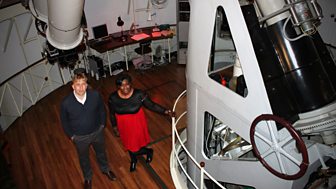
On the volcanic peaks of La Palma, revolutionary new telescopes and cutting-edge technology are opening a new chapter in our exploration of space. High above the clouds, The Sky at Night team meet the scientists uncovering clues to the universe's greatest mysteries. Hunting for cosmic collisions that forge the gold in your wedding ring, capturing gamma rays from giant black holes and exploding stars, and seeking out elusive ‘dark matter’, their discoveries will change the way we look at the cosmos forever. \n\nThe team begin their La Palma adventure with the Cherenkov Telescope Array Observatory, or CTAO. Chris Lintott meets this mega-project’s director general, Dr Stuart McMuldroch, the day after its inauguration, and what he reveals is staggering. Built to detect the most powerful electromagnetic radiation – gamma rays – the CTAO will be able to capture particles with 150 trillion times the energy of visible light. And it does so not by looking far out into space but by focusing just a few kilometres up. \n\nWatching for fast, faint flashes of blue Cherenkov light made by gamma rays striking atoms in our atmosphere and then tracking the trajectories of the gamma rays back into space, the CTAO will uncover the secrets of some of the most exotic and violent environments in the cosmos – the mouths of huge black holes and exploding stellar giants. Most excitingly, it will answer questions we haven’t yet even thought to ask. \n\nBack in the UK, Maggie Aderin travels to the University of Warwick to see Dr Lisa Kelsey, an astrophysicist with a deep interest in ‘explosive transients’ – things that go bang in the night sky. Lisa and her team are using data from a special robotic telescope at the La Palma observatory, GOTO-N, to search for these transients, and a vast network of citizen scientists are helping them do it. \n\nTheir 5,000 volunteers play a daily game of spot-the-difference, looking for changes in images taken by GOTO-N. And so far, they have discovered supernovae, variable stars and dwarf novae. But the hunt goes on for kilonovae. These cataclysmic mergers of neutron stars, the densest objects in the universe aside from black holes, produce elements heavier than a normal star can forge - from the gold in your wedding ring to the uranium powering our nuclear reactors. \n\nReturning to La Palma and our guest presenter, Maggie Lieu, we’re off to the William Herschel Telescope with Prof Gavin Dalton. Gavin’s new instrument, WEAVE, is revolutionising the telescope’s capabilities and may help us to better understand one of the most mysterious substances in the cosmos. \n\nThe genius of WEAVE is its efficiency. One hundred kilometres of fibre-optic cables, ending in tiny prisms and placed precisely by robots, allow the instrument to observe and take spectra for up to 900 astronomical objects at once, inside and outside our galaxy simultaneously. It can run multiple projects at the same time, and one of these projects is a survey of five million stars in the Milky Way. As Maggie discovers, from the spectra generated by this survey, scientists will be able to get incredibly accurate speeds and motions of the stars, allowing them to spot any invisible gravitational attractors – the telltale sign of elusive dark matter. \n\nAt the Gran Telescopio Canarias, the largest optical telescope of its type in the world, Chris gets a guided tour from Prof Vikram Dhillon. He is there to see how the high-speed camera HiPERCAM is opening up new possibilities and avenues of discovery in astronomy. \n\nMounted on its giant telescope, the 10.4-metre mirror collects huge amounts of light, allowing the camera to take up to 1,000 exposures per second. It can accurately observe some of the fastest-moving objects in the night sky, from binary stars orbiting each other, to spinning black holes and rapidly occulting dwarf planets. And the discoveries are mind-blowing. \n\nWith decades of heritage and new technology coming online all the time, the Roque de los Muchachos Observatory is surely one of the world’s most important hubs for space science, allowing us to expand the horizon of our knowledge of the cosmos. And from the beginning, British scientists have been heavily involved, something that continues to this day. Discoveries and breakthroughs are coming thick and fast, and, most importantly, when you look up from the mountain peak at the night sky, it takes your breath away.
Source: BBC 4
Most recent episodes of The Sky at Night
The Sky At Night

La Palma - Gateway To The Universe
On the volcanic peaks of La Palma, revolutionary new telescopes and cutting-edge technology are opening a new chapter in our exploration of space. High above the clouds, The Sky ...
09-11-2026
BBC 4

The Sky At Night

Space For Different Perspectives
When most people think of dyslexia, they think of difficulties in reading and writing. But while this is correct, it isn’t the full picture. In this episode, Maggie Aderin ...
13-10-2026
BBC 4
The Sky At Night

Engineering The Universe
Chris Lintott and the team explore the extraordinary engineering, both on Earth and millions of kilometres above it in space, that is transforming modern astronomy and revealing ...
15-09-2026
BBC 4
The Sky At Night
Big Black Holes And Little Red Dots
Professor Brian Cox joins the team to explore one the greatest current mysteries in astronomy - little red dots. Discovered by the James Webb Space Telescope (JWST), they have u ...
11-08-2026
BBC 4
The Sky At Night
The Aliens Next Door?
Could alien life exist closer than we think - perhaps right next door? A paper published in 2025 suggested that strange markings discovered on Mars could provide some of the str ...
15-07-2026
BBC 4
The Sky At Night
Space Weather: The Perfect Storm
Life on Earth depends on the sun for its light and its warmth. But the activity of our nearest star also poses a serious threat to all of us. In the most extreme cases, solar st ...
09-06-2026
BBC 4
The Sky At Night
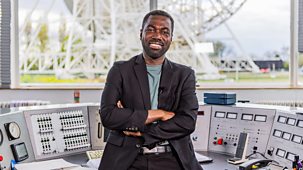
Jodrell Bank: Tuning Into The Universe
It started 80 years ago with a field, army surplus, wartime radar and a visionary idea - and it changed how we see the universe forever. In this episode, we step inside the rema ...
12-05-2026
BBC 4
The Sky At Night
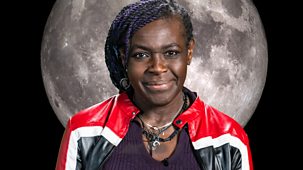
Destination Moon
Maggie Aderin, self-proclaimed lunar-tic, examines Nasa’s Artemis II mission: the first crewed journey towards the moon in more than 50 years. It’s a mission designe ...
14-04-2026
BBC 4
The Sky At Night

Space Mysteries: The Sky At Night Meets Curious Cases
Do aliens exist, and can we talk to them? What does a black hole sound like? Does the universe look like a doughnut? In a spectacular season finale, The Sky at Night teams up wi ...
13-11-2025
BBC 4
The Sky At Night
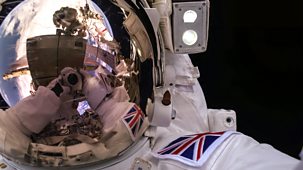
Brits In Space
Three, two, one, lift off! This edition launches into the extraordinary - and extraterrestrial - world of astronaut training, discovering what it truly takes to become a Europea ...
15-10-2025
BBC 4
Most popular episodes of The Sky at Night
The Sky At Night
Space For Different Perspectives
When most people think of dyslexia, they think of difficulties in reading and writing. But while this is correct, it isn’t the full picture. In this episode, Maggie Aderin ...
13-10-2026
BBC 4
The Sky At Night
Engineering The Universe
Chris Lintott and the team explore the extraordinary engineering, both on Earth and millions of kilometres above it in space, that is transforming modern astronomy and revealing ...
15-09-2026
BBC 4
The Sky At Night
The Aliens Next Door?
Could alien life exist closer than we think - perhaps right next door? A paper published in 2025 suggested that strange markings discovered on Mars could provide some of the str ...
15-07-2026
BBC 4
The Sky At Night
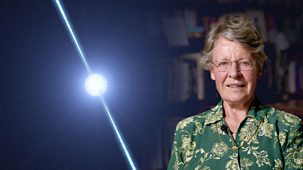
Queen Of Pulsars
Dame Jocelyn Bell Burnell is a discoverer and an explorer of the distant cosmos, and she has walked among the stars. She discovered the first pulsar in 1967 - a discovery so imp ...
14-08-2025
BBC 4
The Sky At Night

Webb Telescope: The Story So Far
In July 2022, the James Webb Space Telescope released its first images. They were visually stunning, and it was clear they provided more detail of stars, galaxies and planets th ...
11-07-2024
BBC 4
The Sky At Night
Space Rock Return
The Sky at Night is back for a brand new series, and this month it is delving into Nasa’s OSIRIS-REx mission, which last year brought back a sample from the near-Earth ast ...
11-04-2024
BBC 4
The Sky At Night
Space Mysteries: The Sky At Night Meets Curious Cases
Do aliens exist, and can we talk to them? What does a black hole sound like? Does the universe look like a doughnut? In a spectacular season finale, The Sky at Night teams up wi ...
13-11-2025
BBC 4
The Sky At Night
Big Black Holes And Little Red Dots
Professor Brian Cox joins the team to explore one the greatest current mysteries in astronomy - little red dots. Discovered by the James Webb Space Telescope (JWST), they have u ...
11-08-2026
BBC 4
The Sky At Night
Ancestral Skies
This month, The Sky at Night teams up with BBC Ideas to discover the secrets of archaeology and astronomy and to reflect on our ancestral skies. \n\nThroughout history and acros ...
14-11-2024
BBC 4