
Catch up TV

Space for Different Perspectives
When most people think of dyslexia, they think of difficulties in reading and writing. But while this is correct, it isn’t the full picture. In this episode, Maggie Aderin is on a journey of discovery. After an adult diagnosis of dyslexia, she is attempting to understand how her own life and work have been affected by the condition. And to do so, she seeks out scientists at the very top of their game, utilising a whole constellation of dyslexic traits in their own research. \n\nAlong the way, she heads to the Open University, where PhD candidate Jessica Hogan studies the vents of the icy moon Enceladus from a lab here on Earth. This involves an ingenious set-up, using a vacuum chamber to mimic the freezing, low-pressure environment of Enceladus in an attempt to understand its mysterious hidden oceans – and maybe, to aid in the search for alien life. But how has her enhanced problem-solving, a trait associated with dyslexia, aided in the engineering of her experiments? \n\nMaggie also visits the University of Cambridge, where Dr Floor van Donkelaar works to understand the mass distribution in very young galaxies. These cosmic toddlers have been throwing out some big surprises – they are much ‘clumpier’ and more uneven than expected, and Floor’s research could be key to improving our understanding of how the universe evolved. Maggie discovers that visual thinking, another trait reported as a strength amongst many dyslexics, may be aiding Floor in her investigations. \n\nStepping away from space science for a moment, Maggie meets up with Dr Helen Taylor. Helen’s research crosses academic boundaries, taking in evolutionary anthropology, psychology and neuroscience, seeking to look at dyslexia differently. She has theorised that dyslexia is a consequence of human cognitive evolution, which has expanded our species’ capacity to gather information and evolve into the societies we live in today. \n\nAnd finally, Maggie heads to one of the UK’s most secure and secretive facilities, Government Communications Headquarters (GCHQ). The centre of Britain’s signals and cyber intelligence efforts, part of GCHQ's job is to protect us from threats from space. Here, she meets a real-life spy and fellow dyslexic, from whom she learns why GCHQ actively recruit from the neurodivergent population. His pattern recognition skills aren’t just keeping us safe but are also used in his personal joy in looking up at the skies.\n\nFrom computational astrophysics and engineering to secret intelligence work, Maggie reveals how diverse ways of thinking are helping us to explore the universe and uncover its greatest mysteries.
Source: BBC 4
Most recent episodes of The Sky at Night
The Sky At Night

Space For Different Perspectives
When most people think of dyslexia, they think of difficulties in reading and writing. But while this is correct, it isn’t the full picture. In this episode, Maggie Aderin ...
12-10-2026
BBC 4

The Sky At Night

Engineering The Universe
Chris Lintott and the team explore the extraordinary engineering, both on Earth and millions of kilometres above it in space, that is transforming modern astronomy and revealing ...
15-09-2026
BBC 4
The Sky At Night

Big Black Holes And Little Red Dots
Professor Brian Cox joins the team to explore one the greatest current mysteries in astronomy - little red dots. Discovered by the James Webb Space Telescope (JWST), they have u ...
11-08-2026
BBC 4
The Sky At Night

The Aliens Next Door?
Could alien life exist closer than we think - perhaps right next door? A paper published in 2025 suggested that strange markings discovered on Mars could provide some of the str ...
15-07-2026
BBC 4
The Sky At Night

Space Weather: The Perfect Storm
Life on Earth depends on the sun for its light and its warmth. But the activity of our nearest star also poses a serious threat to all of us. In the most extreme cases, solar st ...
09-06-2026
BBC 4
The Sky At Night
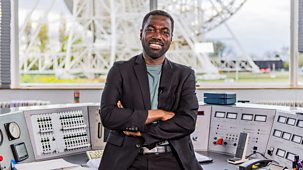
Jodrell Bank: Tuning Into The Universe
It started 80 years ago with a field, army surplus, wartime radar and a visionary idea - and it changed how we see the universe forever. In this episode, we step inside the rema ...
12-05-2026
BBC 4
The Sky At Night
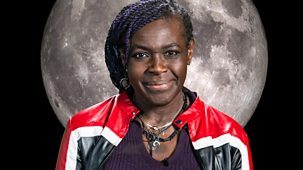
Destination Moon
Maggie Aderin, self-proclaimed lunar-tic, examines Nasa’s Artemis II mission: the first crewed journey towards the moon in more than 50 years. It’s a mission designe ...
14-04-2026
BBC 4
The Sky At Night

Space Mysteries: The Sky At Night Meets Curious Cases
Do aliens exist, and can we talk to them? What does a black hole sound like? Does the universe look like a doughnut? In a spectacular season finale, The Sky at Night teams up wi ...
13-11-2025
BBC 4
The Sky At Night
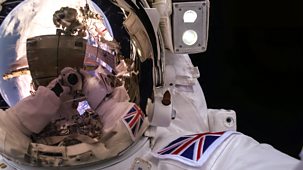
Brits In Space
Three, two, one, lift off! This edition launches into the extraordinary - and extraterrestrial - world of astronaut training, discovering what it truly takes to become a Europea ...
15-10-2025
BBC 4
The Sky At Night

The Expanding Universe
The team explores one of the greatest discoveries of modern astronomy - that our universe is expanding - and the new questions it raises about how the cosmos works.\n\nIn the 19 ...
10-09-2025
BBC 4
Most popular episodes of The Sky at Night
The Sky At Night
Engineering The Universe
Chris Lintott and the team explore the extraordinary engineering, both on Earth and millions of kilometres above it in space, that is transforming modern astronomy and revealing ...
15-09-2026
BBC 4
The Sky At Night

Webb Telescope: The Story So Far
In July 2022, the James Webb Space Telescope released its first images. They were visually stunning, and it was clear they provided more detail of stars, galaxies and planets th ...
11-07-2024
BBC 4
The Sky At Night
Big Black Holes And Little Red Dots
Professor Brian Cox joins the team to explore one the greatest current mysteries in astronomy - little red dots. Discovered by the James Webb Space Telescope (JWST), they have u ...
11-08-2026
BBC 4
The Sky At Night
The Aliens Next Door?
Could alien life exist closer than we think - perhaps right next door? A paper published in 2025 suggested that strange markings discovered on Mars could provide some of the str ...
15-07-2026
BBC 4
The Sky At Night
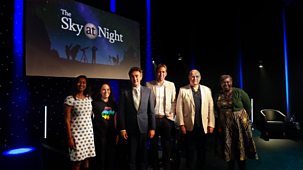
Question Time
A special ‘Question Time’ edition of the programme, recorded at the Civic Theatre, Chelmsford, as part of the British Science Association’s annual science fest ...
22-09-2021
BBC 4
The Sky At Night

The Hunt For Et
Are we alone? Geneticist Dr Adam Rutherford seeks to define what life is and Maggie Aderin-Pocock explores our chances of finding it in the universe.
14-09-2014
BBC 4
The Sky At Night

Guides: 3. Stars
For as long as humans have walked the Earth, the stars have fascinated us. But we have come a long way since the earliest days of astronomy when we had nothing but our eyes to o ...
09-01-2022
BBC 4
The Sky At Night

Beyond Venus
Chris and Maggie report on the reaction to the dramatic announcement of the discovery of phosphine gas in the clouds of Venus, a gas that could be a sign of life. Venus remains ...
11-11-2020
BBC 4
The Sky At Night
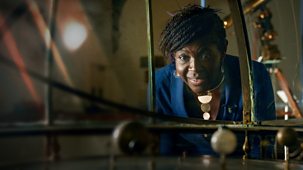
Ancestral Skies
This month, The Sky at Night teams up with BBC Ideas to discover the secrets of archaeology and astronomy and to reflect on our ancestral skies. \n\nThroughout history and acros ...
14-11-2024
BBC 4
The Sky At Night

How Gravity Shapes The Universe
The team travels to the Brecon Beacons AstroCamp to see how gravity shapes the universe. Chris finds out about the newest moon in the solar system.
18-05-2014
BBC 4