
Catch up TV

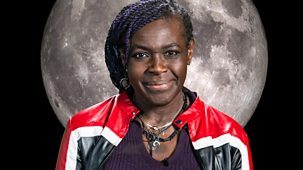
Destination Moon
Maggie Aderin, self-proclaimed lunar-tic, examines Nasa’s Artemis II mission: the first crewed journey towards the moon in more than 50 years. It’s a mission designed to carry astronauts around the moon’s far side and safely home again, marking the furthest human beings will have travelled into space.\n\nWhile the programme explores the mission’s progress on and off the launch pad as Artemis II prepares for its next attempt at lift-off, George Dransfield visits Imperial College London to speak with Dr Helen Sharman, who became the first British astronaut in 1991 when she travelled to the Mir space station. Helen offers insight into what it’s like to wait for launch and why the moon is once again drawing the world’s attention.\n\nBut the renewed focus on the moon goes beyond sending people there. A series of robotic landers has recently attempted to reach the lunar surface, with mixed outcomes. To understand this new phase of exploration, Maggie heads to the Open University to meet Dr Simeon Barber, who is developing his latest lunar instrument. Not every mission carrying his instruments has succeeded, but as he explains, setbacks are as informative as successes and form part of the fast-moving international effort to return to the moon.\n\nBut it’s not only astronauts and robots that get the chance to study our closest neighbour. We all see it as we go about our everyday lives, and Pete Lawrence is on hand to highlight what to look out for if you pause for a moment, glance upward and take in its quiet beauty.\n\nIt is the slow and steady progress of China’s Chang’e programme that brought back the first samples from the moon’s far side in 2024. Chris Lintott meets Professor Yang Li at University College London to find out what those samples are telling Yang and his team, and the clues it gives us to a long-standing puzzle: the stark differences between the near and far sides of our lunar neighbour.\n\nThese developing insights only strengthen the desire to explore further. To understand what Artemis II might contribute, Maggie speaks with Nasa’s Dr Kelsey Young, who leads the mission’s lunar science objectives. She explains what the first people to see the moon up close in more than half a century are trained to be looking out for.\n\nWill Artemis II be sweeping around the moon by the time this programme airs, or will we be waiting a little longer for lift-off? Whatever happens with the journey back to the moon, the story is advancing, whether Artemis II flies or not. There are new scientific clues already coming from lunar samples, and robotic landers still pushing forward with fresh attempts and data. The moon's secrets, history and untapped potential keep drawing us back, urging us to look up and explore the lunar surface once again.
Source: BBC 4
Most recent episodes of The Sky at Night
The Sky At Night

Space For Different Perspectives
When most people think of dyslexia, they think of difficulties in reading and writing. But while this is correct, it isn’t the full picture. In this episode, Maggie Aderin ...
12-10-2026
BBC 4

The Sky At Night

Engineering The Universe
Chris Lintott and the team explore the extraordinary engineering, both on Earth and millions of kilometres above it in space, that is transforming modern astronomy and revealing ...
15-09-2026
BBC 4
The Sky At Night

Big Black Holes And Little Red Dots
Professor Brian Cox joins the team to explore one the greatest current mysteries in astronomy - little red dots. Discovered by the James Webb Space Telescope (JWST), they have u ...
11-08-2026
BBC 4
The Sky At Night

The Aliens Next Door?
Could alien life exist closer than we think - perhaps right next door? A paper published in 2025 suggested that strange markings discovered on Mars could provide some of the str ...
15-07-2026
BBC 4
The Sky At Night

Space Weather: The Perfect Storm
Life on Earth depends on the sun for its light and its warmth. But the activity of our nearest star also poses a serious threat to all of us. In the most extreme cases, solar st ...
09-06-2026
BBC 4
The Sky At Night
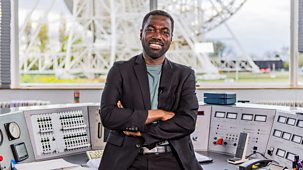
Jodrell Bank: Tuning Into The Universe
It started 80 years ago with a field, army surplus, wartime radar and a visionary idea - and it changed how we see the universe forever. In this episode, we step inside the rema ...
12-05-2026
BBC 4
The Sky At Night
Destination Moon
Maggie Aderin, self-proclaimed lunar-tic, examines Nasa’s Artemis II mission: the first crewed journey towards the moon in more than 50 years. It’s a mission designe ...
14-04-2026
BBC 4
The Sky At Night

Space Mysteries: The Sky At Night Meets Curious Cases
Do aliens exist, and can we talk to them? What does a black hole sound like? Does the universe look like a doughnut? In a spectacular season finale, The Sky at Night teams up wi ...
13-11-2025
BBC 4
The Sky At Night
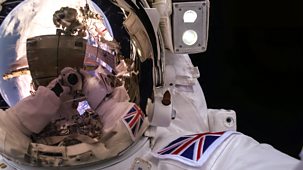
Brits In Space
Three, two, one, lift off! This edition launches into the extraordinary - and extraterrestrial - world of astronaut training, discovering what it truly takes to become a Europea ...
15-10-2025
BBC 4
The Sky At Night

The Expanding Universe
The team explores one of the greatest discoveries of modern astronomy - that our universe is expanding - and the new questions it raises about how the cosmos works.\n\nIn the 19 ...
10-09-2025
BBC 4
Most popular episodes of The Sky at Night
The Sky At Night
Engineering The Universe
Chris Lintott and the team explore the extraordinary engineering, both on Earth and millions of kilometres above it in space, that is transforming modern astronomy and revealing ...
15-09-2026
BBC 4
The Sky At Night

Webb Telescope: The Story So Far
In July 2022, the James Webb Space Telescope released its first images. They were visually stunning, and it was clear they provided more detail of stars, galaxies and planets th ...
11-07-2024
BBC 4
The Sky At Night
Big Black Holes And Little Red Dots
Professor Brian Cox joins the team to explore one the greatest current mysteries in astronomy - little red dots. Discovered by the James Webb Space Telescope (JWST), they have u ...
11-08-2026
BBC 4
The Sky At Night
The Aliens Next Door?
Could alien life exist closer than we think - perhaps right next door? A paper published in 2025 suggested that strange markings discovered on Mars could provide some of the str ...
15-07-2026
BBC 4
The Sky At Night

Question Time
A special ‘Question Time’ edition of the programme, recorded at the Civic Theatre, Chelmsford, as part of the British Science Association’s annual science fest ...
22-09-2021
BBC 4
The Sky At Night

The Hunt For Et
Are we alone? Geneticist Dr Adam Rutherford seeks to define what life is and Maggie Aderin-Pocock explores our chances of finding it in the universe.
14-09-2014
BBC 4
The Sky At Night

Guides: 3. Stars
For as long as humans have walked the Earth, the stars have fascinated us. But we have come a long way since the earliest days of astronomy when we had nothing but our eyes to o ...
09-01-2022
BBC 4
The Sky At Night

Beyond Venus
Chris and Maggie report on the reaction to the dramatic announcement of the discovery of phosphine gas in the clouds of Venus, a gas that could be a sign of life. Venus remains ...
11-11-2020
BBC 4
The Sky At Night
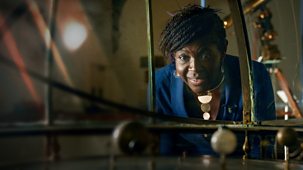
Ancestral Skies
This month, The Sky at Night teams up with BBC Ideas to discover the secrets of archaeology and astronomy and to reflect on our ancestral skies. \n\nThroughout history and acros ...
14-11-2024
BBC 4
The Sky At Night

How Gravity Shapes The Universe
The team travels to the Brecon Beacons AstroCamp to see how gravity shapes the universe. Chris finds out about the newest moon in the solar system.
18-05-2014
BBC 4