
Catch up TV

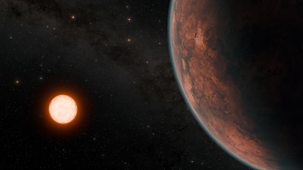
Exoplanets - Strange New Worlds
The team go on a cosmic adventure, exploring one of the newest areas of modern astronomy – the search for exoplanets, the distant bodies that orbit stars beyond our own solar system. These strange new worlds are transforming our understanding of how planets form, where we can look for potentially habitable ones and just how unique, or not, our own Earth may be. \n\nThis captivating new field intrigued presenter George Dransfield so much that she left her secure teaching job to go back to university to study for a PhD, and so she was thrilled by the opportunity to travel to Germany, where ESA’s Plato spacecraft is being built. This cutting-edge mission will study exoplanets like never before. Dubbed 'the planet hunter', Plato will use its 26 cameras to scan over 2,000 sun-like stars to search for rocky Earth-like planets. With each camera capturing 81.4-megapixel images, the resulting two-billion-pixel overall view will be the largest ever for a space mission. George meets ESA’s Thomas Walloschek and OHB’s Pablo Jorba Coloma, to talk about the engineering challenges they have overcome, before going to see the space craft in the clean room where it is being built.\n\nBack in the UK, Chris Lintott takes us on a quick tour through 30 years of exoplanet discovery and shares a possibly endless list of the strange new worlds that have been found. He also meets Dr Edward Bryant, from the University of Warwick, whose recent discovery of planet TOI-6894 b was published in June. This Saturn-sized gas giant, orbiting a tiny red dwarf star, defies current models of planet formation and raises new questions about how such massive planets can form around such small stars. Could our models be missing something fundamental? \n\nMeanwhile, Maggie Aderin-Pocock explains the mystery of the exoplanet Radius Valley - with the help of some sweets, of course! She then speaks to Larissa Palethorpe, whose PhD research in this area led to the discovery of Gliese 12 b, the closest Earth-sized planet in the habitable zone found to date.\n\nAs ever, Pete Lawrence is on hand with practical stargazing tips for the summer months, including how to spot and photograph the 'moon illusion' - an optical trick that makes the moon appear unusually large when it’s near the horizon. With the moon sitting low in the sky during this phase of its 18.6-year cycle, it’s the perfect time to try capturing this stunning effect. \n\nFinally, we conclude this episode with a celebration of Chris Lintott’s 25 years since his first appearance on the programme. \n\nThe strange new worlds being uncovered through exoplanet research offer a rich and thought-provoking glimpse into the incredible diversity of planets across the universe and prompt us to consider just how rare, or common, our place in it might be, and this programme takes you on a journey to explore them from the comfort of your own sofa!
Source: BBC 4
Most recent episodes of The Sky at Night
The Sky At Night

Space For Different Perspectives
When most people think of dyslexia, they think of difficulties in reading and writing. But while this is correct, it isn’t the full picture. In this episode, Maggie Aderin ...
13-10-2026
BBC 4

The Sky At Night

Engineering The Universe
Chris Lintott and the team explore the extraordinary engineering, both on Earth and millions of kilometres above it in space, that is transforming modern astronomy and revealing ...
15-09-2026
BBC 4
The Sky At Night

Big Black Holes And Little Red Dots
Professor Brian Cox joins the team to explore one the greatest current mysteries in astronomy - little red dots. Discovered by the James Webb Space Telescope (JWST), they have u ...
11-08-2026
BBC 4
The Sky At Night

The Aliens Next Door?
Could alien life exist closer than we think - perhaps right next door? A paper published in 2025 suggested that strange markings discovered on Mars could provide some of the str ...
15-07-2026
BBC 4
The Sky At Night

Space Weather: The Perfect Storm
Life on Earth depends on the sun for its light and its warmth. But the activity of our nearest star also poses a serious threat to all of us. In the most extreme cases, solar st ...
09-06-2026
BBC 4
The Sky At Night

Jodrell Bank: Tuning Into The Universe
It started 80 years ago with a field, army surplus, wartime radar and a visionary idea - and it changed how we see the universe forever. In this episode, we step inside the rema ...
12-05-2026
BBC 4
The Sky At Night
Destination Moon
Maggie Aderin, self-proclaimed lunar-tic, examines Nasa’s Artemis II mission: the first crewed journey towards the moon in more than 50 years. It’s a mission designe ...
14-04-2026
BBC 4
The Sky At Night

Space Mysteries: The Sky At Night Meets Curious Cases
Do aliens exist, and can we talk to them? What does a black hole sound like? Does the universe look like a doughnut? In a spectacular season finale, The Sky at Night teams up wi ...
13-11-2025
BBC 4
The Sky At Night
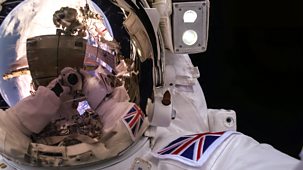
Brits In Space
Three, two, one, lift off! This edition launches into the extraordinary - and extraterrestrial - world of astronaut training, discovering what it truly takes to become a Europea ...
15-10-2025
BBC 4
The Sky At Night

The Expanding Universe
The team explores one of the greatest discoveries of modern astronomy - that our universe is expanding - and the new questions it raises about how the cosmos works.\n\nIn the 19 ...
10-09-2025
BBC 4
Most popular episodes of The Sky at Night
The Sky At Night
Engineering The Universe
Chris Lintott and the team explore the extraordinary engineering, both on Earth and millions of kilometres above it in space, that is transforming modern astronomy and revealing ...
15-09-2026
BBC 4
The Sky At Night
Space For Different Perspectives
When most people think of dyslexia, they think of difficulties in reading and writing. But while this is correct, it isn’t the full picture. In this episode, Maggie Aderin ...
13-10-2026
BBC 4
The Sky At Night
The Aliens Next Door?
Could alien life exist closer than we think - perhaps right next door? A paper published in 2025 suggested that strange markings discovered on Mars could provide some of the str ...
15-07-2026
BBC 4
The Sky At Night
Big Black Holes And Little Red Dots
Professor Brian Cox joins the team to explore one the greatest current mysteries in astronomy - little red dots. Discovered by the James Webb Space Telescope (JWST), they have u ...
11-08-2026
BBC 4
The Sky At Night

Webb Telescope: The Story So Far
In July 2022, the James Webb Space Telescope released its first images. They were visually stunning, and it was clear they provided more detail of stars, galaxies and planets th ...
11-07-2024
BBC 4
The Sky At Night
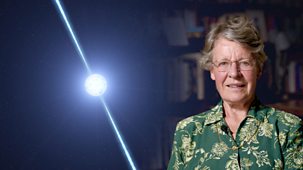
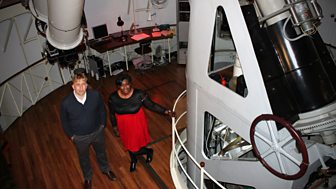
Queen Of Pulsars
Dame Jocelyn Bell Burnell is a discoverer and an explorer of the distant cosmos, and she has walked among the stars. She discovered the first pulsar in 1967 - a discovery so imp ...
14-08-2025
BBC 4
The Sky At Night
The Sky At Day
The British weather is often the enemy of stargazers up and down the country. A forecast of a couple of hours of cloud cover will disappoint even the most determined amateur ast ...
13-07-2022
BBC 4
The Sky At Night

Gaia: A Galactic Revolution
For past three and a half years, ESA's Gaia Space telescope has been mapping the heavens in unprecedented detail. At the end of April 2018 it released precise data on over 1.3 b ...
17-05-2018
BBC 4
The Sky At Night

Guides: 1. Planets
The planets have fascinated us for millennia, but over the past 60 years our understanding of them has been transformed. Using The Sky at Night archives, Maggie Aderin-Pocock ta ...
17-05-2018
BBC 4