Catch up TV


Big Black Holes and Little Red Dots
Professor Brian Cox joins the team to explore one the greatest current mysteries in astronomy - little red dots. Discovered by the James Webb Space Telescope (JWST), they have upended everything we thought we knew about black holes and the evolution of the universe itself. \n\nAstronomical monsters, with the power to devour stars and even to stop time itself, black holes have both fascinated and troubled physicists for decades. Their study has led to breakthroughs in our understanding of gravity, quantum mechanics and even precision manufacturing. \n\nThe journey begins with black holes 101, as Chris Lintott and Brian Cox discuss what they are. And as it turns out, that is a harder question to answer than you might think. Distortions in space-time. Regions of infinite density. Gateways to other universes. The end of time. These are all descriptions of what black holes are, yet somehow all are insufficient – mathematically accurate yet physically unproven. What we thought we knew was that they are born in the violent deaths of massive stars, but this may not always be the case, and that has huge implications for how the cosmos we see today came to be. \n\nMaggie Aderin travels to the University of Nottingham to meet Dr Emma Chapman, a cosmologist whose work focuses on the early universe. She explains the significance of JWST’s discovery of the little red dots and why they are forcing the scientific community to re-evaluate not only how black holes form but also how galaxies themselves grow and evolve. \n\nReturning to Chris and Brian, the discussion turns to some of the alternative theories, and some of the explanations are truly staggering, from black hole suns, created by partially collapsed stars, to primordial black holes, born in the first moments of creation, and direct collapse black holes. \n\nAt the University of Edinburgh, George Dransfield meets Professor Sadegh Khochfar. Using months of processing time on the world’s most advanced supercomputers, his team have created the most detailed simulations of the universe’s first billion years. Their findings are shedding light on whether direct collapse black holes could exist and whether the density of the early universe could provide the answer to how massive black holes form without first forming stars, something once thought impossible. \n\nWhile the nature of the little red dots themselves are still contested, they are making us re-evaluate what we understand about black holes, and in doing so, they provide a window into conditions so extreme that we’re forced to question our assumptions about the very nature of reality and the fundamental physics that underpins the universe. \n\nBut while understanding the universe is a challenge, there is still always joy in looking up at the skies above, and Dr Becky Smethurst is guest presenting this month’s star guide to take us through the treats coming up in the next few weeks.\n\nJoin us on an exploration of the skies and the latest in our understanding of black holes – the cosmic Rosetta Stones that spark wonder in the scientific community and far beyond.
Source: BBC 4
Most recent episodes of The Sky at Night
The Sky At Night

Engineering The Universe
Chris Lintott and the team explore the extraordinary engineering, both on Earth and millions of kilometres above it in space, that is transforming modern astronomy and revealing ...
15-09-2026
BBC 4

The Sky At Night
Big Black Holes And Little Red Dots
Professor Brian Cox joins the team to explore one the greatest current mysteries in astronomy - little red dots. Discovered by the James Webb Space Telescope (JWST), they have u ...
11-08-2026
BBC 4
The Sky At Night

The Aliens Next Door?
Could alien life exist closer than we think - perhaps right next door? A paper published in 2025 suggested that strange markings discovered on Mars could provide some of the str ...
15-07-2026
BBC 4
The Sky At Night

Space Weather: The Perfect Storm
Life on Earth depends on the sun for its light and its warmth. But the activity of our nearest star also poses a serious threat to all of us. In the most extreme cases, solar st ...
09-06-2026
BBC 4
The Sky At Night

Jodrell Bank: Tuning Into The Universe
It started 80 years ago with a field, army surplus, wartime radar and a visionary idea - and it changed how we see the universe forever. In this episode, we step inside the rema ...
12-05-2026
BBC 4
The Sky At Night
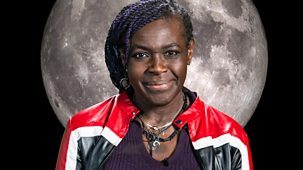
Destination Moon
Maggie Aderin, self-proclaimed lunar-tic, examines Nasa’s Artemis II mission: the first crewed journey towards the moon in more than 50 years. It’s a mission designe ...
14-04-2026
BBC 4
The Sky At Night

Space Mysteries: The Sky At Night Meets Curious Cases
Do aliens exist, and can we talk to them? What does a black hole sound like? Does the universe look like a doughnut? In a spectacular season finale, The Sky at Night teams up wi ...
13-11-2025
BBC 4
The Sky At Night
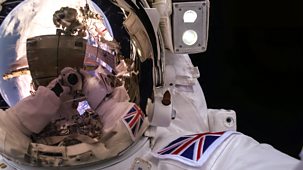
Brits In Space
Three, two, one, lift off! This edition launches into the extraordinary - and extraterrestrial - world of astronaut training, discovering what it truly takes to become a Europea ...
15-10-2025
BBC 4
The Sky At Night

The Expanding Universe
The team explores one of the greatest discoveries of modern astronomy - that our universe is expanding - and the new questions it raises about how the cosmos works.\n\nIn the 19 ...
10-09-2025
BBC 4
The Sky At Night
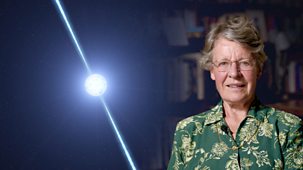
Queen Of Pulsars
Dame Jocelyn Bell Burnell is a discoverer and an explorer of the distant cosmos, and she has walked among the stars. She discovered the first pulsar in 1967 - a discovery so imp ...
14-08-2025
BBC 4
Most popular episodes of The Sky at Night
The Sky At Night
Engineering The Universe
Chris Lintott and the team explore the extraordinary engineering, both on Earth and millions of kilometres above it in space, that is transforming modern astronomy and revealing ...
15-09-2026
BBC 4
The Sky At Night

Webb Telescope: The Story So Far
In July 2022, the James Webb Space Telescope released its first images. They were visually stunning, and it was clear they provided more detail of stars, galaxies and planets th ...
11-07-2024
BBC 4
The Sky At Night
Big Black Holes And Little Red Dots
Professor Brian Cox joins the team to explore one the greatest current mysteries in astronomy - little red dots. Discovered by the James Webb Space Telescope (JWST), they have u ...
11-08-2026
BBC 4

The Sky At Night
The Aliens Next Door?
Could alien life exist closer than we think - perhaps right next door? A paper published in 2025 suggested that strange markings discovered on Mars could provide some of the str ...
15-07-2026
BBC 4
The Sky At Night

The Search For Alien Life
The Sky at Night team investigate the latest science in the hunt for extraterrestrial life. Scientists have never been more obsessed with finding aliens than they are right now. ...
13-04-2023
BBC 4
The Sky At Night
Outback Astronomy
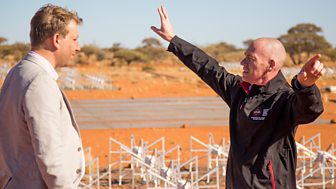
In February 2018, news broke that astronomers had seen the cosmic dawn - the moment when stars first formed, flooding the universe with light. What's remarkable is that this inc ...
12-07-2018
BBC 4