
Catch up TV

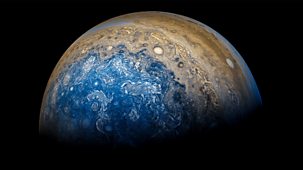
2018: 5. Jupiter Revealed
'To send a spacecraft there is a little bit insane,' says Scott Bolton when talking about Jupiter, the largest planet in the solar system. But that is exactly what he has done, because Scott is head of Juno, the Nasa mission designed to peer through Jupiter's swirling clouds and reveal the wonders within. But this is no ordinary world. This documentary, narrated by Toby Jones, journeys with the scientists into the heart of a giant.\n\nProfessor Kaitlin Kratter shows us how extreme Jupiter is. She has come to a quarry to measure out each planet's mass with rocks, starting with the smallest. Mercury is a single kilogram, and the Earth is 17. But Jupiter is on another scale entirely. It is seven tonnes - that is two and a half times the mass of all the other planets combined. On Kaitlin's scale it is not a pile of rocks, it is the truck delivering them. With extreme size comes extreme radiation. Juno is in the most extreme environment Nasa has visited. By projecting a 70-foot-wide, life-size Juno on a Houston rooftop, Scott shows us how its fragile electronics are encased in 200kg of titanium. As Scott puts it, 'we had to build an armoured tank to go there.'\n\nThe team's efforts have been worthwhile. Professor Andrew Ingersoll, Juno's space weatherman, reveals they have seen lightning inside Jupiter, perhaps a thousand times more powerful than Earth's lightning. This might be evidence for huge quantities of water inside Jupiter. Prof Ingersoll also tells us that the Great Red Spot, a vast hurricane-like storm that could swallow the Earth whole, goes down as far as they can see - 'it could go down 1,000s of kilometres'.\n\nDeeper into the planet and things get stranger still. At the National Ignition facility in northern California, Dr Marius Millot is using powerful lasers normally used for nuclear fusion for an astonishing experiment. He uses '500 times the power that is used for the entire United States at a given moment' to crush hydrogen to the pressures inside Jupiter. Under these extreme conditions, hydrogen becomes a liquid metal. Juno is finding out how much liquid metallic hydrogen is inside Jupiter, and scientists hope to better understand how this flowing metal produces the most powerful aurora in the Solar System.\n\nBut what is at Jupiter's heart? In Nice, Prof Tristan Guillot explains how Juno uses gravity to map the planet's centre. This can take scientists back to the earliest days of the solar system, because Jupiter is the oldest planet and it should contain clues to its own creation. By chalking out an outline of the Jupiter, Tristan reveals there is a huge rocky core - perhaps ten times the mass of Earth. It is now thought Jupiter started as a small rocky world. But there is a surprise, because Juno's findings suggest this core might be 'fuzzy'. Tristan thinks the planet was bombarded with something akin to shooting stars. As he puts it, 'Jupiter is quite unlike we thought'.
Source: BBC 2
Most recent episodes of Horizon
Horizon

The Great British Drought
Documentary from 1976 that explores the drought crisis of that year, going behind the scenes to discover its impact on farming, the landscape and industrial and domestic consumers.
13-06-2026
BBC 2

Horizon
2020: Pluto: Back From The Dead
The incredible story of how Pluto has been propelled from an unremarkable ball of ice on the edge of the solar system to a world of unimaginable complexity - where some form of ...
13-04-2026
BBC 2

Horizon
1997-1998: Mir Mortals
First transmitted in 1998, this is the story of four men who orbited Earth on board the ill-fated Mir space station, which NASA declared unsafe in 1991. Although Mir had been li ...
10-02-2026
BBC 2
Horizon

2022: How To Sleep Well With Michael Mosley
A third of the population regularly struggle with our sleep, which rose to one in two during the pandemic - the highest it’s ever been. However, as more and more people se ...
07-01-2026
BBC 2
Most popular episodes of Horizon
Horizon

2018: 4. Spina Bifida & Me
One in every 1,000 pregnancies in Britain has a spine or brain defect like spina bifida. Thirty years ago, actress Ruth Madeley was one of them. Despite having spina bifida hers ...
26-07-2018
BBC 2
Horizon

2014-2015 - Inside The Dark Web
Series exploring topical scientific issues. With many concerned about internet surveillance, Horizon meets the hackers and scientists whose technology is fighting back.
03-09-2014
BBC 2
Horizon

Life Story: A Horizon Special
It's 1951. There's a race on, and two of the brightest and brashest young men in Cambridge are determined to win it. The prize is glittering. Eternal fame, glory and almost cert ...
11-12-2024
BBC 2
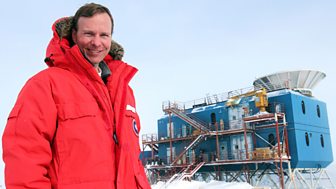

Horizon
2022: How To Sleep Well With Michael Mosley
A third of the population regularly struggle with our sleep, which rose to one in two during the pandemic - the highest it’s ever been. However, as more and more people se ...
07-01-2026
BBC 2
Horizon

The U00a310 Million Challenge
Series exploring topical scientific issues. To celebrate its 50th birthday, Horizon invites the public to play a role in tackling the greatest challenges facing science today.
11-06-2014
BBC 2
Horizon
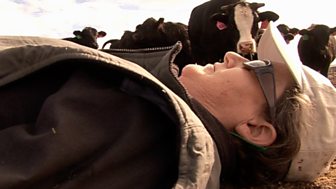
2005-2006: The Woman Who Thinks Like A Cow
Dr Temple Grandin can talk to the animals; she has a legendary ability to read the animal mind and understand animal behaviour when no-one else can. But this is no feat of telep ...
21-06-2018
BBC 2
Horizon

2014-2015 - Should I Eat Meat? - The Big Health Dilemma
Series exploring topical scientific issues. Dr Michael Mosley investigates the latest science on eating meat and puts the studies to the test by going on a high-meat diet.
18-08-2014
BBC 2